In Object oriented programming, the term Object is mainly a process;
It's 'a named object' that transforms Input to Outputs. Usually one of the inputs is the main object to be transformed, some of the other inputs are support objects/components for the main object, and some of the inputs are there to guide/control the process.
Process = Objects put in a certain sequence.
The traditional Hierarchical Organisation primarily recognise the Object responsibility, not Process responsibility.
In practice 'bottom up' has a Object responsibility, and top down has a Process responsibility
'Process mining' can discover the primary sequence
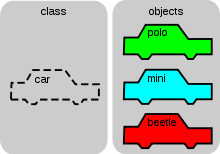

Picture: Object oriented (programming); f.e. a thumb can do certain things
Example: 'A thumb' can do certain things (it can bend). Other fingers can do the same thing.
Noun view = fingers can bend
Verb view (process/method/functions) = bend can fingers - requires time
So an Object can be viewed as a Sub-process; a dishwasher wash dishes

Picture: However Properties/Attributes are the Adjectives; the define the Object (or Noun)
Now the Output from a process is defined usually defined as an Object, and that object has - among other properties - a value (read worth from 'the eye (sense) of the beholder'.

Picture: The concept of 'a vehicle'. An instance

Picture: Guiding Principles, for the object or process ;-) ?
AGA-EAP (pg.8): "Principles should be stable, having a “timeless” quality because they define a value system (as a rule, while methodologies frequently change, values do not)."
'Value for Trade' can be 'Value for Money/Time/Effort/etc'.
Equality - Fair Trade, Good for everyone and no Harm for no-one

Picture: One type of the inputs are Rules/Targets

Picture: Principles are inherited
-------
Justice - Ethics

Picture: Right outcome for stakeholders(effective), Right process (efficient)
--------
The learning process
Step1: Factual: procedures (not named), things, places, ...
Step2: Conceptual; procedures (named), ...., ..., ...
Step3: Pre-dictional; understanding the clockwork for a certain output
Step4: Pre-scriptional; understanding the optimal outcome from various angels.
a) uphold previous levels, b) set a new level, c) uphold new levels

Picture: The right teacher (master) can guide the student improve the process
Key Learning Areas = Subjects = Objects(facts; procedures)
The order in which we learn (do things) can be flexible, a Critical Path Method
The way we combine the objects are
----
They are getting closer, but they still don't see the full picture ;-)

Picture: Corporate Performance Manager suite (Gartner) via PowerPlanner
Reporting = Get data
Budgeting = Resource planning
Forecasting = Output planning
-------
Principles:

Picture: Pyramid of principles
Tier1: Principles to Collaborate; good for all, bad for none (of the stakeholders)
---

Picture: Physical and logical world
---
Free; To resources/process/publish
Fair: Equal rules right/wrong
---
Above all else show the data
Tufte, 1983

Picture: Data ink ratio (the power of simplicity)
------
Deviation Actual / Target

The Business model works perfectly...

Source file: How to combine two tables with different granularity (PowerBI-model)
Physical v.s. Metaphysical limit
Metaphysical = attempts to describe the physical world."The metaphysician attempts to clarify the fundamental notions by which people understand the world, e.g., existence, objects and their properties, space and time, cause and effect, and possibility. "
-----
Sensual art - composition of various sensors
SKU=StockKeepingUnit v.s. Individual

No comments:
Post a Comment