Aug. 14, 2013 — ETH-researchers - have managed to teleport information from A to B -- for the first time in an electronic circuit, similar to a computer chip. Physicists at ETH Zurich have for the first time successfully teleported information in a so-called solid state system. The researchers did it by using a device similar to a conventional computer chip. The essential difference to a usual computer chip is that the information is not stored and processed based on the laws of classical physics, but on those of quantum physics. Quantum teleportation does not transport the information carrier itself, but only the information. "Quantum teleportation is comparable to beaming as shown in the science fiction series Star Trek," says Wallraff. "The information does not travel from point A to point B. Instead, it appears at point B and disappears at point A, when read out at point B." In this system approximately 10,000 quantum bits can be teleported per second. In a next step, the researchers plan to increase the distance between sender and receiver in their device. The scientists say, they will try to teleport information from one chip to another. And in the long term the goal will be to explore whether quantum communication can be realised over longer distances with electronic circuits, more comparable to those achieved today with optical systems. Compared to today's information and communication technologies, which are based on classical physics, quantum information processing has the advantage that the information density is much higher: In quantum bits more information can be stored and more efficiently processed than in classical bits. Source: ScienceDaily Unpublished: Photon based Quantum teleportation with 80% accuracy, Quantum measurement barrier broken, Cancers mutation process described, heavy light
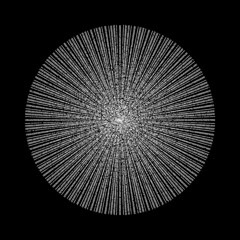
Interesting. Wonder how far this pattern can repeat itself?
The intuitive feeling is of a Conic spiral in terraces, with some kind of bend - maybe linked to the prime constant.
"Coined as the 'Superman' memory crystal, as the glass memory has been compared to the "memory crystals" used in the Superman films, the data is recorded via self-assembled nanostructures created in fused quartz, which is able to store vast quantities of data for over a million years. The information encoding is realised in five dimensions: the size and orientation in addition to the three dimensional position of these nano-structures. Using nano-structured glass, scientists at the University of Southampton have, for the first time, experimentally demonstrated the recording and retrieval processes of five dimensional digital data by femto-second laser writing. The storage allows unprecedented parameters including 360 TB/disc data capacity, thermal stability up to 1000°C and practically unlimited lifetime." Source: ScienceDaily Unpublished: Levitate droplets, PresentationZen, ?, Integrated reporting, CodesOfConduct1, 2, P&G 1pager
How is it that a complex organism evolves from a pile of dead matter? How can lifeless materials become organic molecules that are the bricks of animals and plants? Scientists have been trying to answer these questions for ages. Researchers at the Max Planck Institut für Kohlenforschung have now disclosed the secret of a reaction that has to do with the synthesis of complex organic matter before the origin of life.
Since the 1960's it has been well known that when concentrated hydrogen cyanide (HCN) is irradiated by UV light, it forms an imidazole intermediate that is a key substance for synthesis of nucleobases and nucleotides in abiotic environment. "As I said before, this reaction has nothing to do with heat," says Barbatti. The transformation works in a cold environment, as in comets and in terrestrial ices, where spontaneous HCN polymerization is most expected to occur.
Ramaraja Ramasamy, right, and Yogeswaran Umasankar work together to capture energy created during photosynthesis. Plants are the undisputed champions of solar power. After billions of years of evolution, most of them operate at nearly 100 percent quantum efficiency, meaning that for every photon of sunlight a plant captures, it produces an equal number of electrons. Converting even a fraction of this into electricity would improve upon the efficiency seen with solar panels. During photosynthesis, plants use sunlight to split water atoms into hydrogen and oxygen, which produces electrons. These newly freed electrons go on to help create sugars that plants use much like food to support growth and reproduction. In small-scale experiments, this approach resulted in electrical current levels that are two orders of magnitude larger than those previously reported in similar systems. "In the near term, this technology might best be used for remote sensors or other portable electronic equipment that requires less power to run" Source: link
Inventions comes first (the fun of solving a problem),
then we figure out how far we can go with our new tools. Now where will it happen, and under what morals...
So can we set a path with enough inertia today to take us to where we want to be - our legacy.
The most powerful batteries on the planet are only a few millimeters in size, yet they pack such a punch that a driver could use a cellphone powered by these batteries to jump-start a dead car battery -- and then recharge the phone in the blink of an eye. "This is a whole new way to think about batteries," The new microbatteries offer both power and energy, and by tweaking the structure a bit, the researchers can tune them over a wide range on the power-versus-energy scale. With so much power, the batteries could enable sensors or radio signals that broadcast 30 times farther, or devices 30 times smaller. The batteries are rechargeable and can charge 1,000 times faster than competing technologies "Any kind of electronic device is limited by the size of the battery -- until now" ... like RFID. Source: link
Purpose & Progress; appreciated progress towards a purpose
Builders v.s. Evaluators; the process & the end product
Efficiency & Meaning; putting meaning in each step of the process.
Teamwork, department, company, society, humanity, life; scales of layers of the above.
People in the UK now fit into seven social classes, a major survey conducted by the BBC suggests. More than 161,000 people took part in the Great British Class Survey (the largest study of class in the UK.). Take the Quick test. This research suggests that class has three dimensions - economic, social and cultural.
Elite - the most privileged group in the UK, distinct from the other six classes through its wealth. This group has the highest levels of all three capitals
Established middle class - the second wealthiest, scoring highly on all three capitals. The largest and most gregarious group, scoring second highest for cultural capital
Technical middle class - a small, distinctive new class group which is prosperous but scores low for social and cultural capital. Distinguished by its social isolation and cultural apathy
New affluent workers - a young class group which is socially and culturally active, with middling levels of economic capital
Traditional working class - scores low on all forms of capital, but is not completely deprived. Its members have reasonably high house values, explained by this group having the oldest average age at 66
Emergent service workers - a new, young, urban group which is relatively poor but has high social and cultural capital
Precariat, or precarious proletariat - the poorest, most deprived class, scoring low for social and cultural capital




.jpg)